
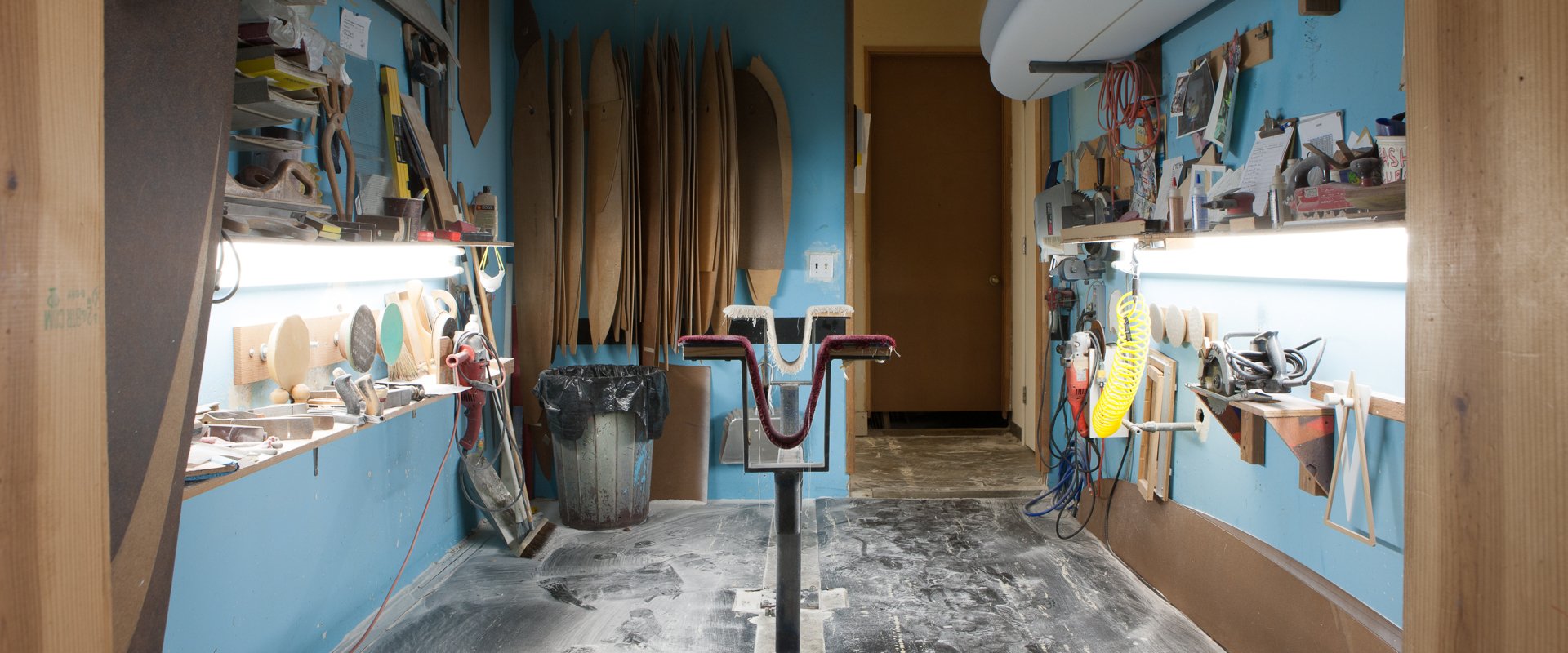
Come by our shop, give us a call or start the conversation below. Our shop staff is on hand to guide you with getting a board that’s just right - whether its writing up a custom order or choosing a board from our showroom. These details below can help us dial you in. We’ll contact you to discuss the details. And in the meantime, if you’re looking to custom order, here’s a custom order form you can print and draw up some potential color designs.
CHOOSING THE RIGHT BOARD
LET’S GET STARTED BY LETTING US KNOW A FEW KEY DETAILS . . .
FAQ - HOW BOARD DESIGN AFFECTS IT’S PERFORMANCE
-
Floatation - The fundamental principle is that a surfboard's mass directly affects its maneuverability; greater mass means more floatation but less agility. Most surfers prefer increased maneuverability, which comes with shorter boards. While making boards thicker or wider can compensate for reduced length, excessive width or thickness may hinder sensitivity and rail-to-rail action. Moderation is key: slightly wider or thicker boards can help a shorter board float, but trade-offs are inevitable.
Paddling - Boards designed specifically for paddling feature less rocker, increased thickness, and narrower shapes, with a rounded and unstable bottom and a fin placed far from the tail. Research shows that at paddling speeds of 3.5 knots, wetted surface causes about 85% of drag, while at 5 knots, outline curves and rocker account for about half of resistance. Full arc-shaped bottoms efficiently displace water, and long, narrow boards glide easily but sacrifice turning ability. When prioritizing paddling, opt for increased size rather than design changes that reduce surfability.
-
Ease of catching waves is a common request. Board size has the most impact—larger boards catch waves more easily. Among boards of equal length, a wider tail captures more wave energy than a narrow one. For example, a 15-inch square tail is more effective than an 11-inch pin tail. However, tail width also influences turning; too wide impedes turning, while too narrow eliminates the necessary curve for rotation. Rocker, rail curve, and tail thickness also play roles in turn ability.
Knee paddling has its own history and challenges. In the past, kneeling was necessary to stay dry while waiting for waves, especially before wetsuits became common. Boards from the 1960s used denser foam and heavier glassing, making them more durable but heavier. Modern boards are lighter and more maneuverable but less resistant to dents. For those who need to knee paddle, a practical solution is to reinforce the knee area with extra layers of glass, adding strength where needed without significant weight gain.
-
Item deNose riding depends on several design characteristics. While greater nose width is helpful, other factors are equally important. Board weight and length both enhance nose riding, with longer boards offering better performance due to their extended rail lines and increased floatation. Tail lift and specific rail configurations, such as traditional 50/50 rails and upturned tail rails, also contribute to nose riding ability. The stock San-O model offers a good balance between nose riding and versatility. scription
-
Increased nose rocker raises water entry resistance and is compounded by a wider nose. It reduces water splash while paddling and lessens the chance of catching the nose during turns. Excessive nose rocker can hinder nose riding.
More center rocker decreases drive and slows paddling, while too little can make the board stiff.
Additional tail rocker improves turning and tip time but slows paddling and drive out of turns. Longer boards tolerate added tail rocker better.
Optimal rocker curves are the result of decades of refinement; the relative shape of each curve is more important than specific measurements.
-
Deeper fins create more grip and make turning harder, while reducing premature tail release.
Wider boards require longer fins for adequate performance.
Increasing fin base provides more lift and drive but reduces side drift necessary for turnability.
More fin rake adds drive and resists rotation.
Front fins positioned closer to the rail can be smaller; moving fins forward makes turning easier by shifting the lift point.
Larger rear fins increase drive and decrease side drift, making turning harder.
Closer fin spacing improves turning but decreases drive; wider spacing has the opposite effect.
Single fins like the HP-1 do not turn as tightly as tri-fins, though some models offer unique handling characteristics.
GETTING YOUR NEW BOARD
All surfboards are must be paid in full (including shipping charges) prior to the board being shipped out.
CALL THE SHOP FOR MORE INFO ON SHIPPING 562 430-5614
Pick up from the shop
Come by the shop smell the neoprene and wax, see some foam dust and we’ll dial you in. 329 Main St. Seal Beach, Ca 90740
California Delivery
If you live from San Diego to the Bay Area you can have your board delivered. Reach out and we can make arrangements 562 430-5614 or contact@harboursurfboards.com
Shipping
Several factors will effect the shipping cost: Picking up your board up at the airport is cheaper (you must make these arrangements with your salesperson at the time of purchase). It is also more cost efficient to have your board delivered to a business address. We will contact you before your board ships to go over the shipping details.
You may choose to have your board shipped to a residence or a business. However, keep in mind that having your board shipped to a business will be less expensive.
Shipping Costs (prices subject to change - contact us for a quote)
Mainland United States - residential address around $280.00 including boxing and packaging
Mainland United States - business address around $237.00 including boxing and packaging
TO HAWAII via ocean freight delivered to will call terminal: $276.00 includes boxing and packaging *we will contact you to go over shipping details *
INTERNATIONAL: *we can contact you with a shipping quote* but be sure to check out our international Harbour Surfboards dealers
**Shipping quotes include insurance. Any claims are subject to the policies of the insurer.
SURFBOARD WARRANTY
All Surfboards sales are final. Our surfboards are handcrafted products and are made from the finest materials to the highest standards in the industry. We guarantee the quality of every board we build. However, we can not guaranteed our surfboards against breakage or damage due to typical use, collisions, sun exposure, improper care, general negligence or natural aging over the surfboards lifetime. If you have warranty concerns for material defects they will be accepted in writing accompanied by proof of purchase and a photograph of the issue within 3 months of the purchase date. If a repair is made by an unauthorized repair shop prior to the claim, the claim will not be accepted. Claims will be reviewed by our factory.
With regards to custom surfboard orders: Color and artwork: Artists' interpretation of any provided drawings may not be exact. Foam spray colors may not match provided samples due to the resin medium. Colored laminations may not match the shade on display. We will gladly give an "estimated" completion time, but due to the complexity of building this hand made product, a definitive completion date can not be guaranteed.